
Saints for January 2
दररोजची ही यादी इटलीच्या बिशपांनी प्रकाशित केलेल्या रोमन संतचरित्रावलीच्या आवृत्तीनुसार दिली आहे. संपूर्ण इटालियन आवृत्ती डाउनलोड करा (मोठी PDF फाइल).
January 2—General Roman Calendar and other local calendars
Saints Basil the Great and Gregory Nazianzen, Bishops and Doctors—Memorial
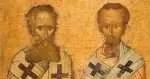
Basil and Gregory became friends while studying in Athens. Their friendship drew them to a life of prayer, and as bishops they helped the faithful profess the divinity of the Son and of the Holy Spirit. Read full reflection >>>
Photograph by Zzvet, Adobe Stock.
Roman Martyrology for January 2
Saint Basil the Great and Saint Gregory Nazianzen, bishops and Doctors of the Church
Friends from their student days in Athens, Basil and Gregory taught the faith of the Church in the Holy Trinity through their preaching and writings. Read full reflection >>>
Vatican News · Roman Martyrology (Italian), January 2, no. 1
Saint Telesphorus, pope and martyr
Saint Telesphorus was the seventh bishop of Rome after the Apostle Peter, as attested by Saint Irenaeus. He governed the Church during a period of early persecution and is remembered as one of the first Roman pontiffs explicitly honored as a martyr. Ancient tradition credits him with contributing to the organization of the Church’s liturgical life, though precise details are sparse. His martyrdom sealed his pastoral witness, and his deposition is commemorated at Rome on this day.
Roman Martyrology (Italian), January 2, no. 2
Saints Argeo, Narciso and Marcellino, martyrs
These three saints are venerated as martyrs in the territory of Cori, south of Rome. Their cult preserves the memory of early Christian witness through martyrdom, likely during one of the Roman persecutions.
Roman Martyrology (Italian), January 2, no. 3
Saint Théodore, bishop of Marseilles
Bishop of Marseille in the sixth century, Theodore sought to restore ecclesiastical discipline within his diocese. His efforts brought him into conflict with secular authorities, particularly Kings Childebert and Guntram, who condemned him and repeatedly drove him into exile. Despite suffering banishment three times, Theodore remained steadfast in his pastoral mission and fidelity to the Church. His endurance under persecution testifies to the cost of episcopal integrity in a turbulent political era.
Roman Martyrology (Italian), January 2, no. 4
Saint Bladulf of Bobbio, priest and monk
Bladulf was a priest and monk at Bobbio in northern Italy. He belonged to the community formed by Saint Columbanus, the Irish missionary who founded Bobbio early in the seventh century. Bladulf is remembered there as a disciple of Columbanus. The Italian monastery and its founder distinguish him from later Irish saints with similar names.
Roman Martyrology (Italian), January 2, no. 5
Saint John the Good, bishop of Milan
During the Lombard invasions, the episcopal seat of Milan had been transferred to Genoa. Giovanni Buono worked to restore the see to Milan, strengthening the city’s ecclesial identity after years of displacement. Renowned for his faith, moral integrity, and pastoral wisdom, he earned affection from both clergy and laity. His episcopate contributed to the stabilization and renewal of the Church in northern Italy.
Roman Martyrology (Italian), January 2, no. 6
Saint Vincentian, hermit
Saint Vincentian lived as a hermit in the territory of Tulle in Aquitaine. Choosing solitude and prayer, he dedicated himself entirely to God in a life of ascetic withdrawal.
Roman Martyrology (Italian), January 2, no. 7
Saint Munchin, bishop of Limerick
Venerated as the first bishop of Limerick, Saint Munchin is an early Irish saint associated with the evangelization and ecclesiastical organization of the region. His cult reflects the deep roots of Christianity in Ireland and the prominence of episcopal saints in its early history.
Nominis (French bishops) · Roman Martyrology (Italian), January 2, no. 8
Saint Adalard, abbot of Corbie
A member of the Carolingian nobility, Adalard renounced political ambition to become a monk and later abbot of Corbie. He is remembered for his administrative wisdom and deep sense of justice, organizing monastic life so that resources were distributed equitably and nothing was wasted. His approach combined discipline with charity, ensuring that all needs were met for the glory of God and the good of the community.
Roman Martyrology (Italian), January 2, no. 9
Blessed Ayrald, Carthusian, bishop of Saint-Jean de Maurienne
Blessed Ayrald lived first as a hermit at Portes-en-Bugey, embracing a life marked by austerity and contemplation shaped by Carthusian customs. Later appointed bishop of Maurienne, he united eremitical discipline with pastoral responsibility. He governed with prudence and wisdom, embodying the balance of solitude and service that characterizes the best traditions of monastic episcopacy.
Roman Martyrology (Italian), January 2, no. 10
Saint Sylvester, abbot at Troina
Sylvester belonged to the Greek monastic tradition of Sicily. He is commemorated at Troina, in the island’s northeastern interior, and the Martyrology describes his life as shaped by the discipline of the Eastern Fathers. The local Church remembers him as an abbot. Little certain information survives about the dates of his life.
Roman Martyrology (Italian), January 2, no. 11
Blessed Marcolino Amanni da Forlì, Dominican priest
A Dominican priest, Marcolino lived a hidden life of humility, simplicity, and silence. He devoted himself to solitude, the service of the poor, and the care and instruction of children. His sanctity was marked not by public preaching but by quiet fidelity and charitable presence, embodying the Dominican spirit through contemplation lived in service. Marcolino Amanni da Forlì was born in 1317 and died in 1397.
Dominican Friars · Roman Martyrology (Italian), January 2, no. 12
Blessed Stefana Quinzani, virgin, Dominican sister
A nun of the Third Order of Saint Dominic, Stefana dedicated her life to deep contemplation of the Passion of Christ. Her spirituality was intensely Christ-centered and expressed through prayer, penance, and devotion. She also labored for the Christian education of girls, uniting contemplative life with apostolic charity. Stefana Quinzani was born in 1457 and died in 1530.
Dominican Friars · Roman Martyrology (Italian), January 2, no. 13
Blessed Guillaume Repin and Laurent Batard, priests and martyrs of Angers
These French priests were martyred during the French Revolution for their fidelity to the Church. Refusing to submit to revolutionary demands that violated their conscience, they were guillotined at Angers. They are remembered among the many clergy who bore witness to Christ and the Church through martyrdom during this period of violent persecution.
Roman Martyrology (Italian), January 2, no. 14
Blessed Marie-Anne Blondin, virgin, founder of the Sisters of Saint Anne at Lachine
Born into poverty in Quebec and remaining illiterate until youth, Marie-Anne Blondin overcame significant personal obstacles to respond to God’s call. She founded the Congregation of the Sisters of Saint Anne, dedicated especially to the education of children in rural farming communities. Despite internal trials and misunderstandings, she persevered in humility and obedience, offering a lasting model of Christian education rooted in charity, patience, and trust in Divine Providence. Born Esther Blondin, she was still unable to read at twenty-two, when she took domestic work in a teaching convent at Terrebonne. Her own experience of exclusion from schooling helped shape her vocation as an educator. Marie-Anne Blondin was born in 1809 and died in 1890.